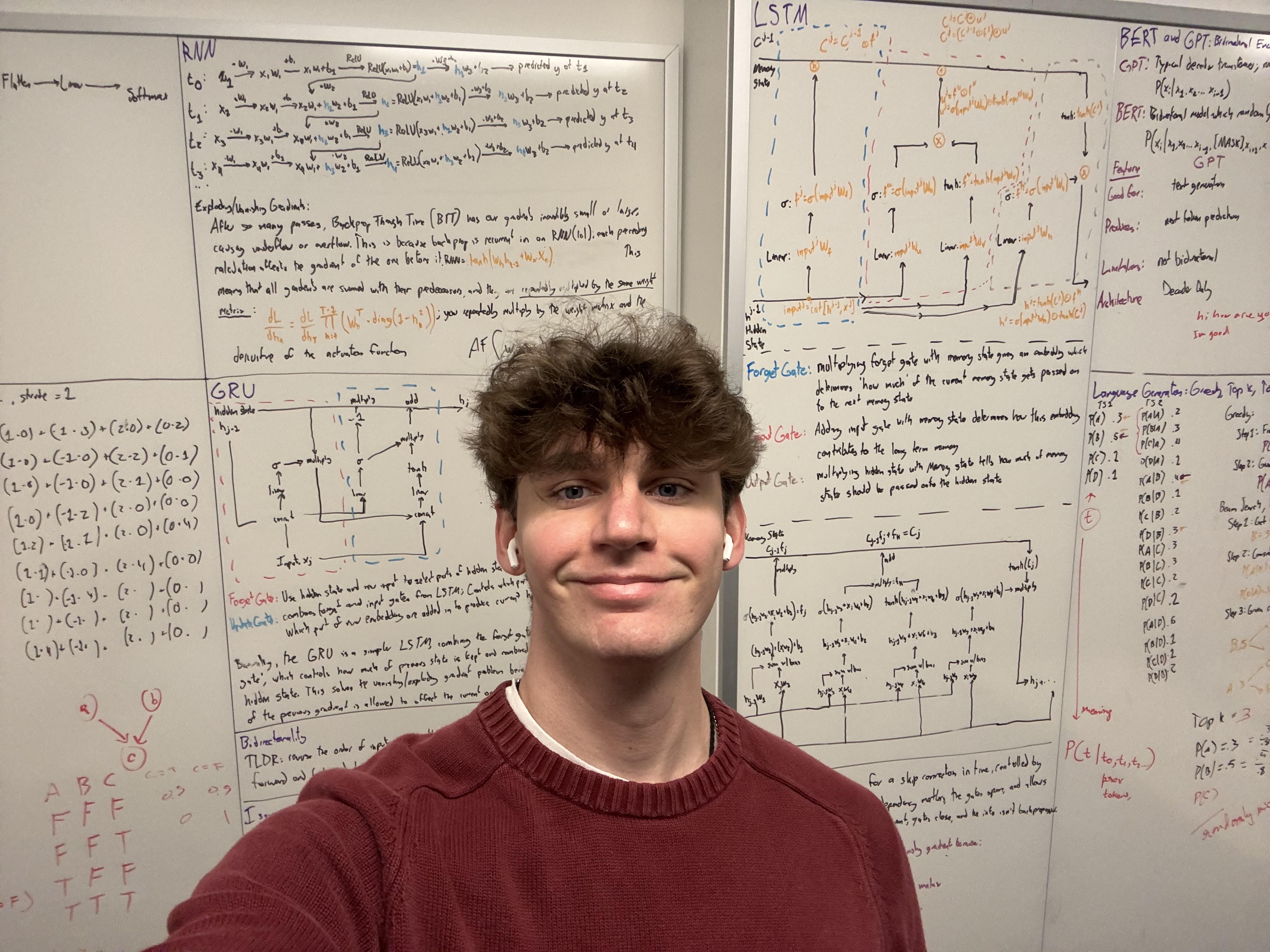
Portrait of Dom Marhoefer in front of a whiteboard with neural network notes

NLP Engineer & Researcher

Dom Marhoefer

Hi! I'm Dom, a Natural Language Processing Master's Student at UC Santa Cruz.

I'm fascinated by computational neurolinguistics (in both biological and artificial systems), and I build pipelines and infrastructure to study the mathematics behind neural communication, linguistic/semantic representations, and why you're able to read this sentence!

Experience
  1. Student Research Engineer, NLP Capstone, Palo Alto, CA

    May 2026 — Present
    Qwen3-OmniMADSSFTRLVR
    • Designing a dual-lane benchmark and post-training framework for speech-native tool-calling voice agents, extending the MADS multi-agent dialog simulator with speech perturbation and structured reasoning over noisy, disfluent audio.
    • Building the dataset-generation pipeline: dialog simulation, text perturbation (fillers, self-corrections), TTS synthesis (Qwen3-TTS / CosyVoice-3), acoustic noise injection (MUSAN / CHiME-5), and automated validation.
    • Planning a two-stage post-training pipeline (SFT + RLVR) on Qwen3-Omni to teach direct audio-to-tool-call reasoning, targeting accuracy, JSON validity, and robustness to acoustic degradation.
  2. Data Operations Intern, Remote

    Jun — Dec 2024
    Pandasscikit-learnNLTKVADERLDA
    • Applied Latent Dirichlet Allocation (LDA) to decompose high-dimensional survey text into latent thematic distributions, identifying key drivers of positive and negative sentiment.
    • Trained Random Forest ensembles to predict participant retention; performed feature importance ranking and data visualization to validate model decision boundaries and interpret patterns.
    • Built a custom preprocessing pipeline using NLTK for lemmatization and stop-word filtering, followed by VADER for lexicon-based sentiment polarity scoring on longitudinal survey data.
  3. R&D Consulting Intern, New York, NY

    Jun — Dec 2023
    Regular expressionspython-docx
    • Architected a regex-based Named Entity Recognition (NER) system to extract structured insights from highly heterogeneous, unstructured donor prospect data.
    • Developed python-docx scripts to automate the ingestion and normalization of semi-structured text, reducing manual data entry latency and improving downstream relational database integrity.
  4. Data Operations & AI Intern, Remote

    May — Aug 2023
    scikit-learnPandasMeteostat
    • Engineered predictive models for PJM COMED hourly load using 10 years of historical data; integrated weather variables via Meteostat to capture seasonal sensitivities.
    • Achieved an RMSE within ~0.5 MW of PJM institutional benchmarks by optimizing hyperparameter manifolds via RandomizedSearchCV.
    • Developed a tail-weighted evaluation pipeline aligned with Energy Price Thresholds (EPT), prioritizing model accuracy during peak volatility periods to optimize battery arbitrage logic.
Education
UC Santa Cruz, Silicon Valley Extension logo

UC Santa Cruz, Silicon Valley Extension

M.S. Natural Language Processing

Santa Clara, CA

Expected Mar 2027

Involvement

  • Sharf Lab·Graduate Researcher
    • Engineered a Python wrapper for the 3Brain BioCam MEA system for real-time control of 4,096 electrode channels, with asynchronous ZMQ pipelines streaming raw neural signals for spike sorting and stimulation.
    Sep 2025 — May 2026
New York University logo

New York University

B.A. Economic Policy & Language and Mind

New York, NY

Jul 2024

Involvement

  • Camp Kesem·Development Coordinator
    • Led multi-year fundraising initiatives raising $50K+ annually, coordinating 50 counselors and supporting 100+ campers across recurring programs.
    2020 — 2024
  • Zeta Beta Tau·Co-President and Philanthropy Chair
    • Directed operations for a 70-member chapter, managing budgets, university relations, and executive board decisions.
    2022 — 2024
  • The B+ Foundation·Team Captain
    • Ran campus-wide fundraising campaigns for pediatric cancer research, coordinating volunteers and raising $15K+.
    2022 — 2024
Selected Work
PyTorchTransformersRoBERTa

UCSC NLP at SemEval-2026 Task 10: Boundary-Aware Span Extraction and RoBERTa Classification for Conspiracy Detection

2026

SemEval-2026 Task 10 (PsyCoMark): conspiracy-marker span extraction and document-level detection

Subtask 1: Conspiracy Marker Extraction

  • Built a RoBERTa-large span classifier over enumerated candidate spans (up to 32 tokens), with boundary-aware representations combining start/end embeddings, mean-pooled span content, span-width embeddings, and adjacent context tokens.
  • Used IoU≥0.95 positive labeling with hard-negative mining (IoU 0.50–0.75) and per-role positive-class weighting to sharpen boundary discrimination under severe span imbalance.
  • Designed containment-based non-maximum suppression and span merging to resolve overlapping and nested predictions across five conspiracy roles (Actor, Action, Effect, Evidence, Victim).
  • Ranked 7th of participating systems on the official test set (0.2251 macro F1, token-level IoU≥0.5).

Subtask 2: Document-level Conspiracy Classification

  • Fine-tuned a RoBERTa-large sequence classifier over the [CLS] representation to predict document-level conspiracy stance (Yes / No / Can't tell), trained independently from the span model with no cross-task feature sharing.
  • Applied label smoothing and a stratified 90/10 train–validation split to stabilize training under class imbalance.
  • Ranked 12th of participating systems on the official test set (0.7694 weighted F1).
PyTorchTransformersLlama-3.2

fMRIFlamingo: Benchmarking Llama-3.2 for Semantic fMRI Decoding

2026

Direct fMRI-to-language decoder mapping brain activity into a frozen Llama-3.2-1B, with a blind-control study exposing a language-prior illusion in its apparent success

  • Originated the project and designed fMRIFlamingo: a brain tokenizer, Perceiver Resampler, and gated cross-attention layers mapping fMRI BOLD activity into a frozen Llama-3.2-1B, adapting the OpenFlamingo multimodal architecture to neural decoding.
  • Achieved 42.86% Top-1 accuracy on a 1-in-100 next-word ranking task, well above chance — then designed a blind-control ablation (zeroed fMRI input) that revealed the apparent success was driven by the frozen language prior, not the neural signal.
  • Selected and prepared the Huth et al. narrative-listening fMRI dataset, and diagnosed the failure down to the per-window level (near-identical token distributions between held-out and zero-fMRI conditions) to distinguish it from simple posterior collapse.
Let's Connect
Reach out for
  • -Collaborations in NLP and computational neuroscience
  • -ML/DL engineering or applied research opportunities
  • -Open-source projects at the intersection of language and neural systems
  • -General questions about my work or experience
Learn more about me
Contact
Based inSanta Clara, CA

Open to remote opportunities and relocating for the right role.

© 2026 Dom Marhoefer